
Exam maintenance is an ongoing, collaborative process that keeps NBEO examinations current and relevant. Committees review and refine exam questions, while councils build on that work through further content review and evaluation of existing questions. Guided by ICE Standard 20.5 (2021), this process considers item analysis, reliability, decision consistency, speededness, item response time and candidate feedback to inform exam updates and support exam quality.
How NBEO aligns with best practices:
"Examination evaluation information should include...item analysis, reliability, decision consistency, speededness, item response time, and candidate feedback..."
Standard 20.5, 2021, ICE
A Job Task Analysis (JTA) is a study of the tasks professionals perform and the knowledge and skills needed to carry them out safely and effectively. Through input from practicing professionals (sometimes referred to as subject-matter experts), a JTA helps establish an exam’s content and the emphasis given to each area. This process provides an evidence-based foundation for exam development, helping keep examinations aligned with current practice and focused on the competencies essential to patient care.
How NBEO aligns with best practices:
"...a close link between test content and the job or professional occupational requirements should be demonstrated.”
Standard 11.3, 2014, AERA, APA, NCME
Learn More
NBEO content outlines and matrices (together, referred to as “exam blueprints”) provide the framework for what each examination assesses, outlining the content areas and competencies candidates are expected to demonstrate. They guide exam development and give candidates and educators a clearer understanding of the scope of each exam. Together, these resources support NBEO’s focus on assessing the knowledge and skills needed for safe and effective entry into independent optometric practice.
Review the Part I ABS, Part II PAM/TMOD and Part III PEPS exam blueprints.
How NBEO aligns with best practices:
“…The [blueprint] must provide precise direction regarding the weighting structure for each section.”
Standard 15c, 2021, NCCA
Item writing transforms the knowledge and skills outlined in NBEO’s exam blueprints into questions and clinical cases. Licensed, practicing optometrists serve as subject-matter experts, drawing on their expertise to develop content that reflects current standards of care. Each submission undergoes multiple levels of review by committees and councils to refine its clarity, accuracy and clinical relevance before approval for use on an exam. This collaborative process helps ensure that exam content assesses the competencies needed for safe and effective optometric practice.
How NBEO aligns with best practices:
“The program must use … a systematic process for developing items to ensure that examination content is accurate, current, fair and appropriate..."
Standard 11.3, 2014, AERA, APA, NCME
Item review is a collaborative process that helps ensure exam questions are clear, accurate and relevant to current optometric practice. After an item writer submits a question and receives feedback from an exam director, committee members review and refine its content and wording. Councils provide an additional level of review, building on the committees’ work to prepare questions for potential inclusion on an exam. Together, these reviews help keep exam content aligned with NBEO’s blueprints and focused on the knowledge and skills needed for safe and effective practice.
How NBEO aligns with best practices:
“The test review process should include empirical analysis and/or the use of expert judges to review items and scoring criteria...”
Standard 4.8, 2014, AERA, APA, NCME
Form assembly brings reviewed exam questions together to create a complete version of an examination, known as an exam form. Guided by the exam blueprint, questions are selected to meet established requirements for content coverage, emphasis and difficulty. Because forms may still vary slightly in difficulty, a statistical process called equating accounts for those differences so scores remain comparable. Together, form assembly and equating support consistent assessment and fair scoring across different versions of the exam.
How NBEO aligns with best practices:
“… supporting evidence should be provided for any claim that scale scores earned on alternate forms of a test may be used interchangeably.”
Standard 5.12, 2014, AERA, APA, NCME
Exam administration puts the exam development process into practice by delivering examinations under standardized conditions. From candidate check-in and testing instructions to monitoring and procedures for addressing testing irregularities, each step supports a consistent testing experience. These safeguards help protect exam integrity and provide candidates with a fair opportunity to demonstrate their knowledge and skills.
How NBEO aligns with best practices:
“Test administrators should follow carefully the standardized procedures of administration and scoring..."
Standard 6.1, 2014, AERA, APA, NCME
Standard setting establishes the level of performance candidates must demonstrate to pass an examination. Through a structured process, subject-matter experts define the expectations for an optometrist who is entering the profession and translate those expectations into a passing score. This approach bases passing decisions on an established standard of competence, not on how candidates perform relative to one another, supporting NBEO’s mission to protect the public through competency assessment.
How NBEO aligns with best practices:
“…performance standards must be based on generally accepted psychometric principles consistent with the purpose of the examination and item format(s) used.”
Standard 17.A, 2021, ICE
Validity refers to the extent to which evidence supports the interpretation and use of exam scores for their intended purpose. For NBEO, this means supporting the use of scores to assess optometric competency at the point of initial licensure. Building that evidence is an ongoing process that connects job task analysis, exam blueprints, expert content review and statistical evaluation. Together, these activities help establish a sound foundation for meaningful scores and defensible decisions about candidate competence.
Exam security protects the confidentiality of exam content and the integrity of candidate results. NBEO’s safeguards include controlled access to exam materials, testing rules and monitoring, data forensics and confidentiality requirements that prohibit unauthorized use or sharing of exam content. These measures help prevent unfair advantages and support confidence that scores reflect candidates’ own knowledge and skills, not prior access to protected material.
Fairness means giving candidates an equitable opportunity to demonstrate the knowledge and skills an examination is designed to assess. It requires attention throughout exam development, administration and scoring, from reviewing questions for potential bias to providing appropriate accommodations that remove barriers without changing the competencies being measured. These practices help ensure that scores reflect candidate competence rather than factors unrelated to safe and effective optometric practice.
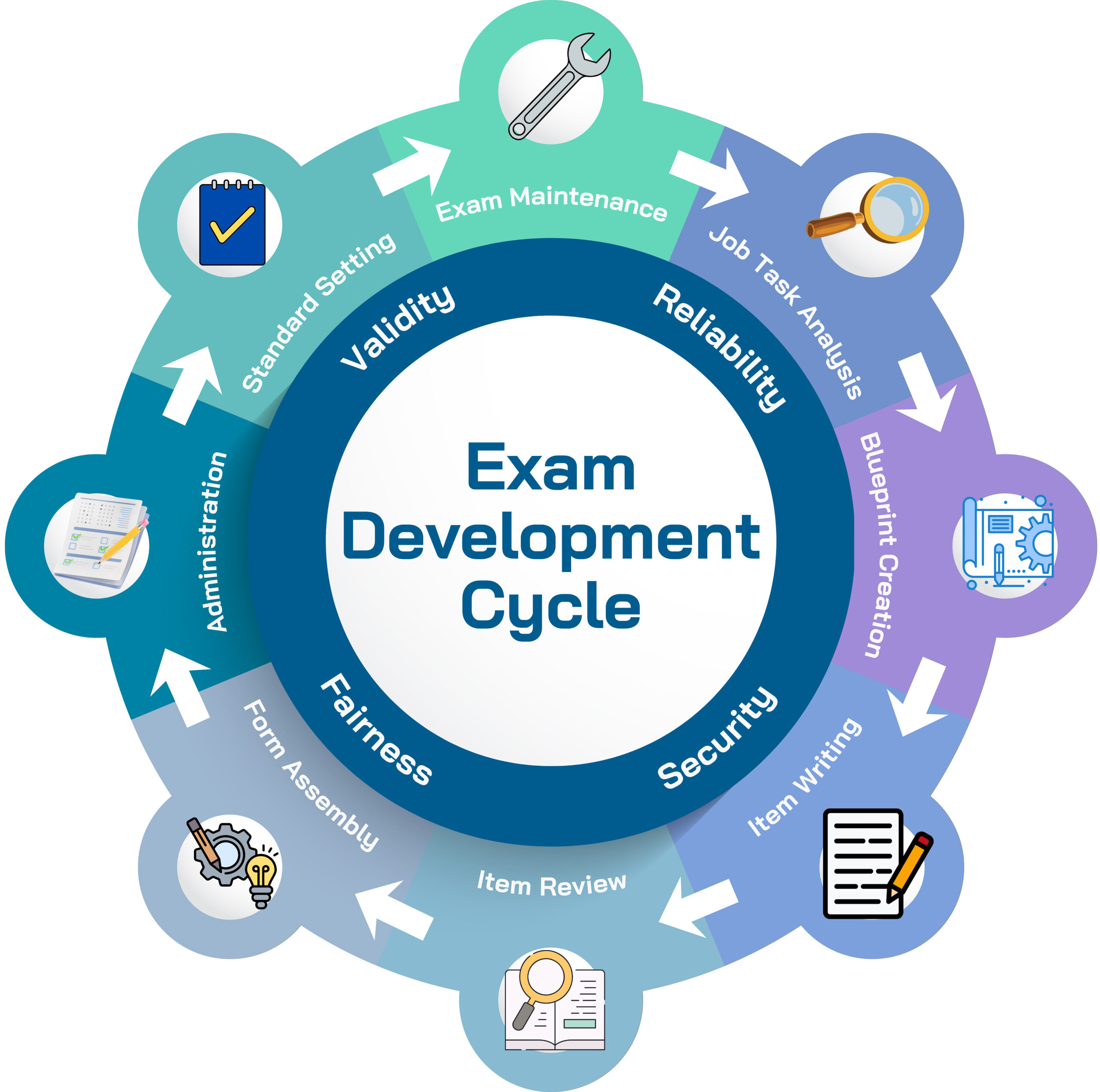
For 75 years, the National Board of Examiners in Optometry® (NBEO®) has supported the profession’s commitment to safe, competent patient care. Each examination we administer represents the work of a much larger, continuous process: a carefully designed exam development cycle grounded in professional standards, clinical relevance, professional input, and public protection.
At its core, NBEO’s mission is purpose driven. Regulatory boards rely on NBEO examination results to inform fair and consistent licensure decisions. That responsibility means examinations must do more than assess what candidates can remember on a given day. They must accurately evaluate the knowledge and clinical judgement needed for safe, autonomous optometric practice.